HBSE 8th Class Maths Solutions Chapter 1 Rational Numbers Ex 1.1✦ Step-by-step
Haryana State Board HBSE 8th Class Maths Solutions Chapter 1 Rational Numbers Ex 1.1 Textbook Exercise Questions and Answers.
Haryana Board 8th Class Maths Solutions Chapter 1 Rational Numbers Exercise 1.1
Key concepts used in this exercise
Commutative\(a \times b = b \times a\)
Associative\(a \times (b \times c) = (a \times b) \times c\)
Distributive\(a(b + c) = ab + ac\)
Multiplicative identity\(a \times 1 = a\)
Additive inverse\(a + (-a) = 0\)
Reciprocal\(a \times \frac{1}{a} = 1\)
Question 1 (i)Distributive property
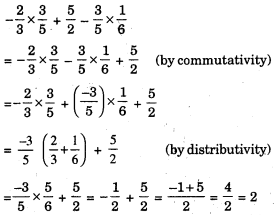
Using appropriate properties, find \(\frac{2}{3} \times \frac{3}{5}+\frac{5}{2}-\frac{3}{5} \times \frac{1}{6}\)
Step 1
\(=\frac{3}{5} \times \frac{2}{3}-\frac{3}{5} \times \frac{1}{6}+\frac{5}{2}\)
Rearrange so the two terms containing \(\frac{3}{5}\) are together (commutative property).
Step 2
\(=\frac{3}{5}\left(\frac{2}{3}-\frac{1}{6}\right)+\frac{5}{2}\)
Take \(\frac{3}{5}\) common — this is the distributive property.
Step 3
\(\frac{2}{3}-\frac{1}{6}=\frac{4}{6}-\frac{1}{6}=\frac{3}{6}=\frac{1}{2}\)
Simplify inside the bracket using LCD 6.
Step 4
\(=\frac{3}{5} \times \frac{1}{2}+\frac{5}{2}=\frac{3}{10}+\frac{5}{2}\)
Step 5
\(=\frac{3}{10}+\frac{25}{10}=\frac{28}{10}\)
Add using LCD 10.
Answer
\(=\frac{14}{5}\)
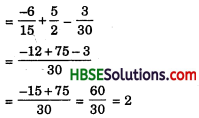
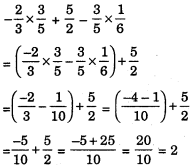
Textbook working (original scan)
Question 1 (ii)Distributive property
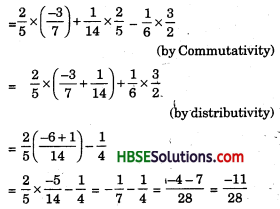
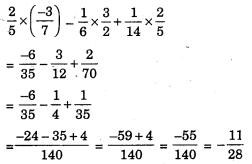
Using appropriate properties, find \(\frac{2}{5} \times\left(\frac{-3}{7}\right)-\frac{1}{6} \times \frac{3}{2}+\frac{1}{14} \times \frac{2}{5}\)
Step 1
\(=\frac{2}{5} \times \frac{-3}{7}+\frac{2}{5} \times \frac{1}{14}-\frac{1}{6} \times \frac{3}{2}\)
Group the two terms containing \(\frac{2}{5}\) (commutative property).
Step 2
\(=\frac{2}{5}\left(\frac{-3}{7}+\frac{1}{14}\right)-\frac{1}{6} \times \frac{3}{2}\)
Take \(\frac{2}{5}\) common (distributive property).
Step 3
\(\frac{-3}{7}+\frac{1}{14}=\frac{-6}{14}+\frac{1}{14}=\frac{-5}{14}\)
Simplify the bracket using LCD 14.
Step 4
\(=\frac{2}{5} \times \frac{-5}{14}-\frac{3}{12}=\frac{-1}{7}-\frac{1}{4}\)
Step 5
\(=\frac{-4}{28}-\frac{7}{28}=\frac{-11}{28}\)
Subtract using LCD 28.
Answer
\(=\frac{-11}{28}\)
Textbook working (original scan)
Question 2Additive inverse
Write the additive inverse of each: (i) \(\frac{2}{8}\) (ii) \(\frac{-5}{9}\) (iii) \(\frac{-6}{5}\) (iv) \(\frac{2}{-9}\) (v) \(\frac{19}{-6}\)
Rule
The additive inverse of a number \(a\) is \(-a\) (just change its sign), because \(a+(-a)=0\).
(i)
additive inverse of \(\frac{2}{8}\) is \(\frac{-2}{8}\)
(ii)
additive inverse of \(\frac{-5}{9}\) is \(\frac{5}{9}\)
(iii)
additive inverse of \(\frac{-6}{5}\) is \(\frac{6}{5}\)
(iv)
\(\frac{2}{-9}=\frac{-2}{9}\), so its additive inverse is \(\frac{2}{9}\)
(v)
\(\frac{19}{-6}=\frac{-19}{6}\), so its additive inverse is \(\frac{19}{6}\)
Question 3Additive inverse
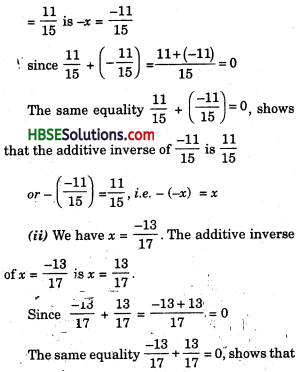
Verify that \(-(-x)=x\) for (i) \(x=\frac{11}{15}\) (ii) \(x=-\frac{13}{17}\)
(i) Step 1
\(x=\frac{11}{15}\Rightarrow -x=\frac{-11}{15}\)
(i) Step 2
\(-(-x)=-\left(\frac{-11}{15}\right)=\frac{11}{15}=x\) ✓
(ii) Step 1
\(x=\frac{-13}{17}\Rightarrow -x=\frac{13}{17}\)
(ii) Step 2
\(-(-x)=-\left(\frac{13}{17}\right)=\frac{-13}{17}=x\) ✓
Textbook working (original scan)
Question 4Multiplicative inverse (reciprocal)
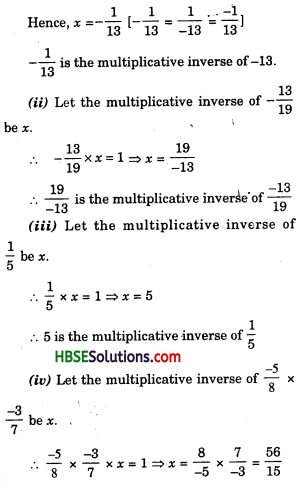
Find the multiplicative inverse of: (i) \(-13\) (ii) \(\frac{-13}{19}\) (iii) \(\frac{1}{5}\) (iv) \(\frac{-5}{8} \times \frac{-3}{7}\) (v) \(-1 \times \frac{-2}{5}\) (vi) \(-1\)
Rule
The reciprocal of \(\frac{a}{b}\) is \(\frac{b}{a}\); their product is \(1\).
(i)
reciprocal of \(-13\) is \(\frac{-1}{13}\)
(ii)
reciprocal of \(\frac{-13}{19}\) is \(\frac{-19}{13}\)
(iii)
reciprocal of \(\frac{1}{5}\) is \(5\)
(iv)
\(\frac{-5}{8} \times \frac{-3}{7}=\frac{15}{56}\Rightarrow\) reciprocal \(=\frac{56}{15}\)
(v)
\(-1 \times \frac{-2}{5}=\frac{2}{5}\Rightarrow\) reciprocal \(=\frac{5}{2}\)
(vi)
reciprocal of \(-1\) is \(-1\), since \(-1 \times -1 = 1\)
Textbook working (original scan)
Question 5Naming properties
Name the property under multiplication used in each: (i) \(\frac{-4}{5} \times 1=1 \times \frac{-4}{5}=-\frac{4}{5}\) (ii) \(-\frac{13}{17} \times \frac{-2}{7}=\frac{-2}{7} \times \frac{-13}{17}\) (iii) \(\frac{-19}{29} \times \frac{29}{-19}=1\)
(i)
\(1\) is the multiplicative identity
Multiplying by 1 leaves the number unchanged.
(ii)
Commutative property
The order of the factors is swapped.
(iii)
Multiplicative inverse
A number times its reciprocal is 1.
Question 6Reciprocal & product
Multiply \(\frac{6}{13}\) by the reciprocal of \(\frac{-7}{16}\).
Step 1
reciprocal of \(\frac{-7}{16}\) is \(\frac{16}{-7}=\frac{-16}{7}\)
Step 2
\(\frac{6}{13} \times \frac{-16}{7}=\frac{6 \times(-16)}{13 \times 7}\)
Answer
\(=\frac{-96}{91}\)
Question 7Associative property
What property allows you to compute \(\frac{1}{3} \times\left(6 \times \frac{4}{3}\right)\) as \(\left(\frac{1}{3} \times 6\right) \times \frac{4}{3}\)?
Observe
only the grouping of the factors changed, not their order.
Rule
\(a \times(b \times c)=(a \times b) \times c\)
Answer
Associative property of multiplication
Question 8Multiplicative inverse
Is \(\frac{8}{9}\) the multiplicative inverse of \(-1\frac{1}{8}\)? Why or why not?
Step 1
\(-1\frac{1}{8}=\frac{-9}{8}\)
Step 2
\(\frac{8}{9} \times \frac{-9}{8}=-1 \neq 1\)
For a multiplicative inverse the product must equal \(+1\).
Answer
No — the inverse of \(\frac{-9}{8}\) is \(\frac{-8}{9}\), not \(\frac{8}{9}\).
Question 9Multiplicative inverse
Is \(0.3\) the multiplicative inverse of \(3\frac{1}{3}\)? Why or why not?
Step 1
\(0.3=\frac{3}{10}\) and \(3\frac{1}{3}=\frac{10}{3}\)
Step 2
\(\frac{3}{10} \times \frac{10}{3}=1\)
Answer
Yes — the product is \(1\), so they are multiplicative inverses.
Question 10Reciprocals
Write: (i) the rational number with no reciprocal; (ii) the rational numbers equal to their reciprocals; (iii) the rational number equal to its negative.
(i)
\(0\)
Division by 0 is not defined, so 0 has no reciprocal.
(ii)
\(1\) and \(-1\)
\(1 \times 1 = 1\) and \(-1 \times -1 = 1\).
(iii)
\(0\)
\(0\) is equal to its own negative, since \(-0 = 0\).
Question 11Fill in the blanks
Fill in the blanks: (i) Zero has …… reciprocal. (ii) The numbers …… and …… are their own reciprocals. (iii) The reciprocal of \(-5\) is …… (iv) Reciprocal of \(\frac{1}{x}\), \(x \neq 0\), is …… (v) The product of two rational numbers is always a …… (vi) The reciprocal of a positive rational number is ……
(i)
no
(ii)
\(1\) and \(-1\)
(iii)
\(\frac{1}{-5}\)
(iv)
\(x\)
(v)
rational number
(vi)
positive